
UAE corporate tax for holding companies: participation exemption, tax groups and free zone holdcos
Understand corporate tax in the UAE for holding companies: dividend exemptions, share gains, tax groups, free zone rules and Pillar Two.

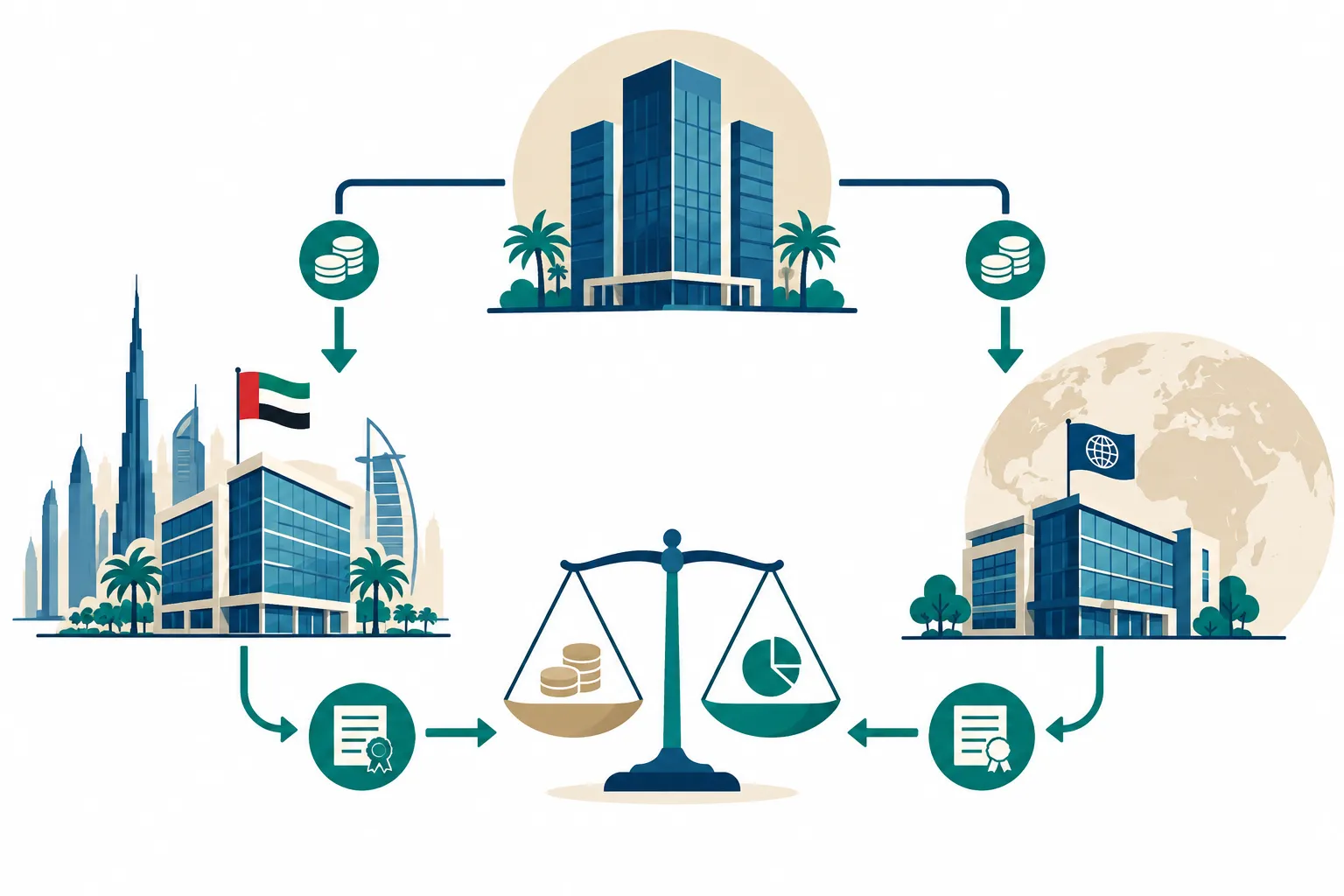
Corporate tax in the UAE applies to holding companies. A UAE company can generally exclude dividends received from a UAE-resident company, while dividends and disposal gains on other shareholdings may qualify for the participation exemption. The choice between a mainland and free zone holding company carries more weight when it also earns taxable income.
For a founder or CFO, the tax rate is only a starting point. The treatment of each receipt, the deductibility of costs and the eligibility of the group structure determine the outcome. Family offices can read Within’s guide to UAE corporate tax for family office holding companies.
The starting position for a UAE holding company
Under Article 3 of Federal Decree-Law No. 47 of 2022 (as amended) and Cabinet Decision No. 116 of 2022, the ordinary rate is 0% on taxable income up to AED 375,000 and 9% on taxable income above that amount. The threshold applies to taxable income, not turnover, cash received or the value of investments. A holding company is not automatically an exempt person simply because it holds shares.
“the Taxable Person’s Taxable Income exceeding 375,000 (three hundred seventy-five thousand dirhams) shall be subject to a 9% (nine percent) Corporate Tax rate in the relevant Tax Period.” - UAE Ministry of Finance, Cabinet Decision No. 116 of 2022, Article 3
The tax computation starts with accounting income, adjusted for exempt receipts, restricted deductions and reliefs. A company may receive an exempt dividend alongside taxable interest, management fees or gains that fail the participation conditions. Even if no corporate tax is payable, registration, records and return obligations can remain. Returns and payment are generally due within nine months after the tax period ends; the FTA Corporate Tax Returns Guide sets out the return framework.
| Receipt or cost | Usual question for the holdco |
|---|---|
| Dividend from a UAE-resident juridical person | Is it excluded as a domestic dividend? |
| Dividend from a foreign subsidiary | Does the shareholding satisfy the participation exemption? |
| Gain on selling subsidiary shares | Does the participation exemption cover the disposal, including any applicable restrictions? |
| Interest or service income | Is it taxable under the ordinary or free zone rules? |
| Borrowing costs | Are they attributable to exempt income or subject to interest deduction limits? |
Dividends and capital gains: two distinct routes to exemption
Dividends from UAE companies
Article 22 of the corporate tax law exempts dividends and other profit distributions received from a UAE-resident juridical person. The recipient does not need to satisfy the foreign-participation ownership and holding-period tests to exclude that domestic dividend. This is an income exemption for the recipient, not a blanket exemption for the company that pays it or for a later sale of its shares.
A family structure with several UAE subsidiaries may receive a dividend from an operating company and later sell its shares. The dividend and sale gain need separate analyses: the gain does not inherit the dividend exemption.
Foreign dividends and share-sale gains: the participation exemption
Article 23 of the law and Ministerial Decision No. 302 of 2024 set the conditions for the participation exemption in the UAE (for tax periods starting on or after 1 January 2025; Ministerial Decision No. 116 of 2023 still governs earlier periods). It covers qualifying dividends and other participation income, including qualifying disposal gains. Any shareholding, UAE or foreign, must meet these conditions before a gain on selling it can be excluded, and a foreign shareholding must also meet them before its dividends can be excluded.
For a typical corporate subsidiary, work through these conditions together:
- Ownership: the UAE taxable person holds at least 5% of the ownership interests in the participation. The decision also treats a stake as meeting the ownership test where its acquisition cost is at least AED 4 million, provided that level is kept for 12 uninterrupted months.
- Holding period: the interest has been held, or is intended to be held, for an uninterrupted period of at least 12 months. If the ownership condition (5%, or the AED 4 million cost route where that is relied on) stops being met before the 12 months are up, income already exempted is brought back into taxable income in that period. A gain on selling the shares before the 12 months are up does not qualify, even if the intention was to hold them longer.
- Subject-to-tax: the participation must be subject to corporate tax, or a similar foreign tax, at a statutory rate of at least 9%. If not, it can still pass by showing an effective tax rate of at least 9%, and there are special rules for holding companies and for participations in qualifying free zone persons or exempt persons. These tests are detailed and depend on the facts.
- Other statutory conditions: the shares must carry at least 5% of distributable profits and liquidation proceeds (or meet the AED 4 million cost route, which also satisfies this), and, where the participation is a related party, not more than 50% of its direct and indirect assets may consist of ownership interests or entitlements that would not have qualified for the exemption if held directly.
The FTA guidance on dividends and participation exemption explains the conditions, although it was written before Ministerial Decision No. 302 of 2024 and does not reflect its related-party limit on the asset test. Keep acquisition documents, the ownership register, holding-period evidence and an analysis of the subsidiary’s tax status with the tax computation.
Suppose a UAE parent receives a distribution from its UAE subsidiary and, in the same tax period, sells shares in that subsidiary or in a foreign subsidiary. Article 22 governs the UAE dividend; Article 23 must be applied separately to a gain on selling either shareholding. Exempt income is removed from taxable income, while a related loss or expense does not automatically offset taxable management fees.
Tax groups, loss transfers and internal reorganisations
A UAE tax group allows eligible resident companies to be treated as a single taxable person, with the parent responsible for the group’s corporate tax compliance. Under Article 40, the parent generally needs to own at least 95% of each subsidiary’s share capital, voting rights and entitlement to profits and net assets, directly or indirectly. Members must meet the other conditions, including the same financial year and the same accounting standards, and must be UAE resident juridical persons that are not treated as resident elsewhere under a tax treaty. An exempt person or a qualifying free zone person cannot join such a group.
For tax-loss transfers between separate taxable persons, Article 38 sets a different ownership test. Qualifying UAE resident juridical persons need at least 75% common ownership, as well as meeting the other conditions and limits on the receiving company’s use of the loss. A 75%-owned subsidiary does not qualify for tax grouping on that basis alone.
| Arrangement | Ownership threshold | What it does | Important boundary |
|---|---|---|---|
| Tax group | 95% | Treats eligible parent and subsidiaries as one taxable person | Qualifying free zone persons and exempt persons cannot be members |
| Tax-loss transfer | 75% common ownership | Allows qualifying losses to move between separate taxable persons | Conditions and utilisation limits still apply |
| Qualifying group asset transfer | 75% common ownership | May allow a qualifying internal asset or liability transfer on a no-gain/no-loss basis | Separate relief, not tax grouping or unrestricted loss sharing |
Article 26 deals with transfers within a qualifying group, as shown in the last row. For an internal transfer of shares or other assets, assess the relief’s conditions. There is a clawback if, within two years of the transfer, the asset or liability is transferred outside the qualifying group or the two companies stop being members of the same qualifying group. The transfer is then treated as made at market value on the original transfer date. A planned sale soon after the restructuring calls for particular care.
Map legal ownership and voting rights before considering a group election. Add each company’s tax status, financial year, brought-forward losses and proposed asset movements. That record will help distinguish tax grouping from loss transfers and restructuring relief; the tax group versus qualifying group distinction is relevant when moving assets between entities.
Mainland versus free zone holding companies
Free zone incorporation does not, by itself, make a UAE corporate tax holding company tax-free. Under Articles 3 and 18 of the corporate tax law, a qualifying free zone person receives 0% on qualifying income and 9% on taxable income that is not qualifying income, without the ordinary AED 375,000 0% band for that non-qualifying income, provided it continues to meet the qualifying conditions, including keeping non-qualifying revenue within the de minimis limit (the lower of 5% of revenue and AED 5 million); if it fails any of them, it loses qualifying status for that period and the next four. It must satisfy the qualifying-person conditions, including adequate substance, applicable transfer-pricing requirements and the relevant income and audit rules. The FTA Free Zone Persons guidance explains that regime, although it predates Ministerial Decision No. 229 of 2025. Where FTA guidance and the legislation differ, the legislation applies.
Holding shares and other securities for investment purposes is a qualifying activity under Ministerial Decision No. 229 of 2025, and shares are deemed to be held for investment purposes when held for an uninterrupted period of at least 12 months. The receipt, counterparty and other activities still need their own classification. If a free zone holdco charges management fees or lends to affiliates, it needs to classify those streams separately from its shareholding income. Headquarter services and treasury and financing services to related parties can themselves be qualifying activities, but only if the conditions are met, and an investment portfolio does not make every receipt qualifying income.
| Question | Mainland holding company | Free zone holding company |
|---|---|---|
| Ordinary taxable income | 0% up to AED 375,000, then 9% | A qualifying free zone person has 0% on qualifying income and 9% on non-qualifying taxable income |
| UAE-resident company dividends | Exemption under Article 22, if conditions apply | Same income exemption can be relevant; free zone location is not the reason for it |
| Foreign participation income | Article 23 exemption if conditions are met | Article 23 may apply; analyse free zone income status separately |
| Grouping | Can join a tax group if Article 40 conditions are met | A qualifying free zone person cannot join a tax group |
| Main operational issue | Classifying income and financing costs | Classifying income and maintaining qualifying free zone status |
Where most receipts are exempt dividends and qualifying participation gains, a free zone licence may add little corporate tax benefit on those receipts. Taxable service, financing and investment income give the choice more weight, as does a group’s wish to consolidate under Article 40.
Ownership and commercial needs also affect where to base a holding company.
Financing, substance and anti-abuse
Debt funding requires a separate calculation. Article 30 limits net interest expenditure to the higher of AED 12 million and 30% of adjusted EBITDA (Ministerial Decision No. 126 of 2023, Article 8), so the limit does not bite where net interest expenditure is AED 12 million or less. Adjusted EBITDA leaves out exempt income, such as qualifying dividends and participation gains. Disallowed interest can be carried forward for 10 tax periods, oldest first, still subject to the 30% limit.
Article 31 separately denies interest on related-party loans used to fund a dividend or profit distribution to a related party, a redemption, repurchase, reduction or return of share capital to a related party, a capital contribution to a related party, or the acquisition of an ownership interest in a person that is or becomes a related party, unless the company shows the main purpose was not a corporate tax advantage (deemed where the lender is taxed on the interest at 9% or more).
Expenditure incurred in earning exempt income is not deductible, and deal costs of buying or selling a participation are capitalised rather than deducted. Interest on borrowing to acquire and hold a participating interest is the main exception: it stays deductible, subject to the interest limitation rules.
Document where directors make investment decisions, who controls financing and how related-party services and loans are priced. Group treasury arrangements and transfer-pricing documentation are relevant where funding runs between affiliates. Adequate substance is an explicit issue for a qualifying free zone person; arm’s-length pricing and evidence of commercial purpose matter across both mainland and free zone structures. Under Article 50’s general anti-abuse rule, the tax authority may counteract an arrangement that is not carried out for a valid commercial or other non-fiscal reason reflecting economic reality, and whose main purpose, or one of its main purposes, is to obtain a corporate tax advantage that is not consistent with the law’s intention or purpose. A paper holding company or circular transaction should not be treated as a substitute for genuine business reasons.
Does Pillar Two change the result for a large group?
For an in-scope multinational group, the UAE’s Top-up Tax (the domestic minimum top-up tax imposed by Cabinet Decision No. 142 of 2024 under Article 3(3) of the corporate tax law) sits alongside ordinary corporate tax and free zone treatment. It is designed to bring the effective rate on relevant UAE profits up to 15% (Article 3(3) of the corporate tax law, and the Annex definition of ‘Minimum Rate’ in Cabinet Decision No. 142 of 2024). The rules apply to groups meeting the consolidated annual revenue threshold of EUR 750 million in at least two of the four preceding financial years, for financial years beginning on or after 1 January 2025. These parameters are set out in the UAE Ministry of Finance’s top-up tax information. The FTA’s Top-up Tax Guide TTGREG1 (August 2026, section 3.1) states that the UAE does not currently have an Income Inclusion Rule (IIR) or an Undertaxed Profits Rule (UTPR).
Top-up Tax is generally worked out for the UAE as a whole: the Pillar Two income and adjusted covered taxes of the group’s UAE constituent entities are combined to give one UAE effective tax rate (minority-owned subgroups and joint ventures are computed separately), and any top-up tax is charged on the excess profit left after the substance-based income exclusion. Applying 15% to one holdco’s accounting profit would miss that calculation. Most dividends are removed from Pillar Two income, but income does not drop out just because it is taxed at 0% in a free zone, so it can pull the UAE rate below 15%.
When senior tax advice is warranted
Get senior advice before a cross-border share disposal, debt-funded acquisition, migration of shares into a new UAE vehicle or group election involving subsidiaries with losses. The exemption, ownership and timing tests can change the tax result. For substantial family assets, the UAE position also needs to account for succession arrangements and foreign tax exposure.
A UAE holdco can benefit from exempt domestic dividends and qualifying participation income. Incorporation alone confers no exemption: the legal and commercial structure must support the treatment of each receipt, cost and relief under the corporate tax law.
This is general information, not tax or legal advice. The treatment of a particular holding depends on its facts and the law applicable to its tax period.
FAQ
How much is the corporate tax in the UAE?
The ordinary rate is 0% on taxable income up to AED 375,000 and 9% on taxable income above that amount. A qualifying free zone person has separate rate rules for qualifying and non-qualifying income, and in-scope large multinational groups may face a domestic minimum top-up tax.
Who has to pay corporate tax in the UAE?
UAE companies, including holding companies and free zone companies, are generally within the corporate tax regime. Whether tax is actually payable depends on taxable income after exemptions, deductions and applicable reliefs; being within scope can still bring registration and return obligations.
How is UAE corporate tax calculated?
Start with the company’s accounting income, remove qualifying exempt receipts, and apply the relevant tax adjustments, deductions, losses and reliefs to arrive at taxable income. Apply the appropriate rate to that taxable income, taking account of the separate rates for a qualifying free zone person where relevant. For large multinational groups, Top-up Tax is a separate calculation, not another rate on the same taxable income.